Air Muka in Malay Culture: A Scoping Review of Face, Politeness, and Interpersonal Relations in Multicultural Contexts
Keywords:
air muka, Malay culture, facework, politeness, interpersonal relations, intercultural communication, scoping reviewAbstract
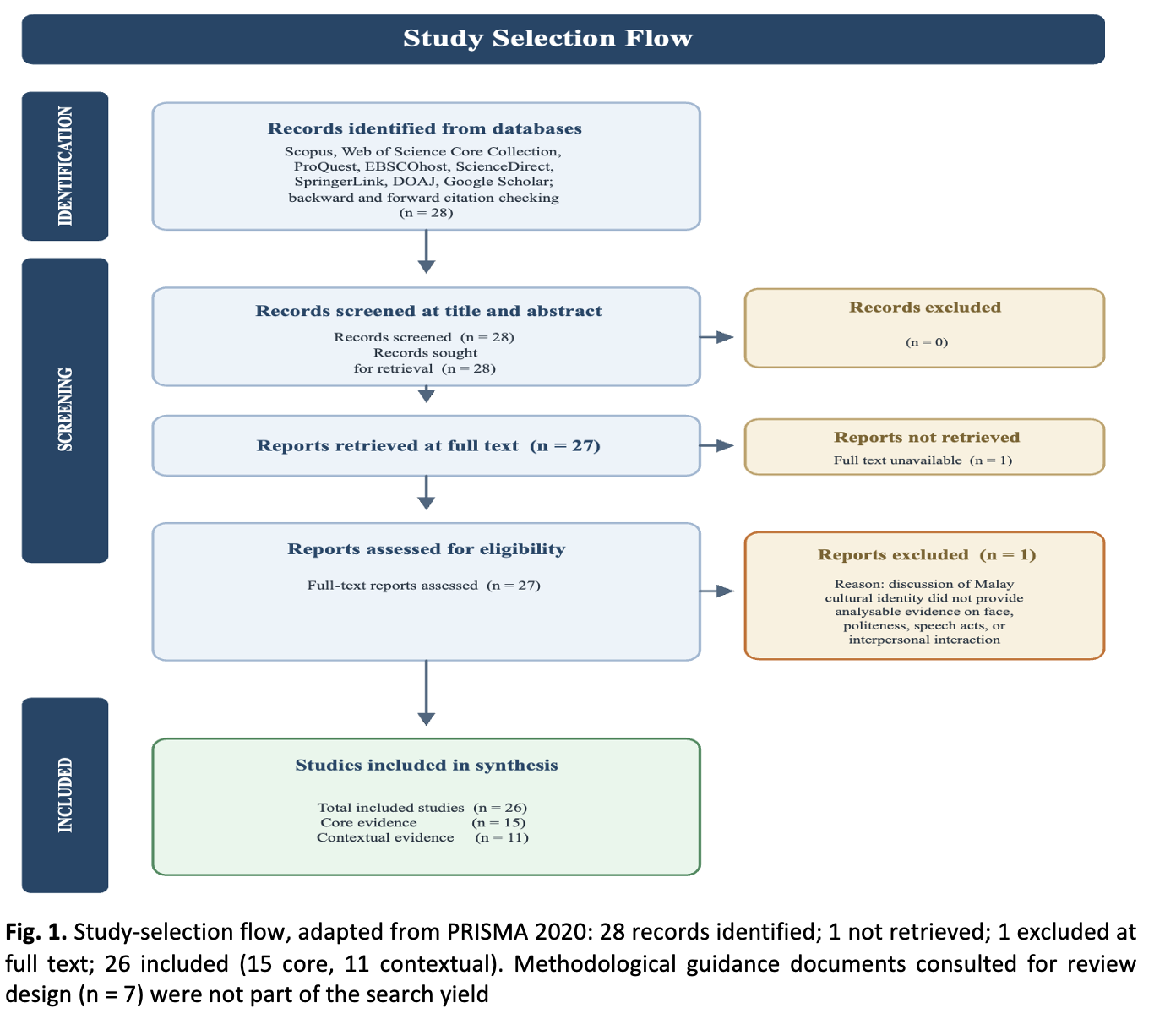
Air muka reflects cultural knowledge regarding face, dignity, status, and social acceptability in Malay conversations. There have been very few efforts to synthesize the literature on politeness, face work, speech acts, intercultural communication, and conflict management from Malaysia and similar Asian settings. This scoping review, conducted according to JBI guidance, examined how English-language scholarship published between January 2021 and September 2026 has treated air muka in Malay and multicultural interaction. Searches of eight databases and supplementary sources yielded 28 topic-relevant records; after full-text screening, 26 studies were included in the thematic synthesis, comprising 15 core studies on Malay or Malaysian interaction and 11 contextual studies that supplied comparative, intercultural, or theoretical perspective. Themes discussed in the study included issues such as dignity and prestige, facework and politeness, mitigation of speech acts, power and status, intercultural relationships, digital communications, conflicts, and relational repair. It can be noted from the literature that “air muka” should be considered an umbrella concept that incorporates concepts like face, dignity, respect, harmony, and relational management. There is ample evidence in the literature on requests, refusals, expressions of gratitude, business communication, teacher-student interactions, and intercultural communication. There are few empirical studies that employ air muka explicitly as a theoretical construct. Many studies focus on related topics without explicitly referring to this term. Read against the universalist model of face and its Asian critiques, the evidence shows that air muka carries a moral and relational weight (dignity, legitimacy, belonging) that individual-centred face models do not capture, which is why the review treats it as a culturally located field rather than as a translation of “face”. Future research would be enhanced by use of naturally-occurring data on Malay discourse, participants’ descriptions of offences and repair, and comparison studies that identify Malay-specific aspects of politeness.