Islamic Education Approach to Digital Parenting: Addressing Technoference and Strengthening Parent-Child Relationships
Keywords:
Islamic education, digital parenting, parental technoference, digital adab, parent-child relationshipAbstract
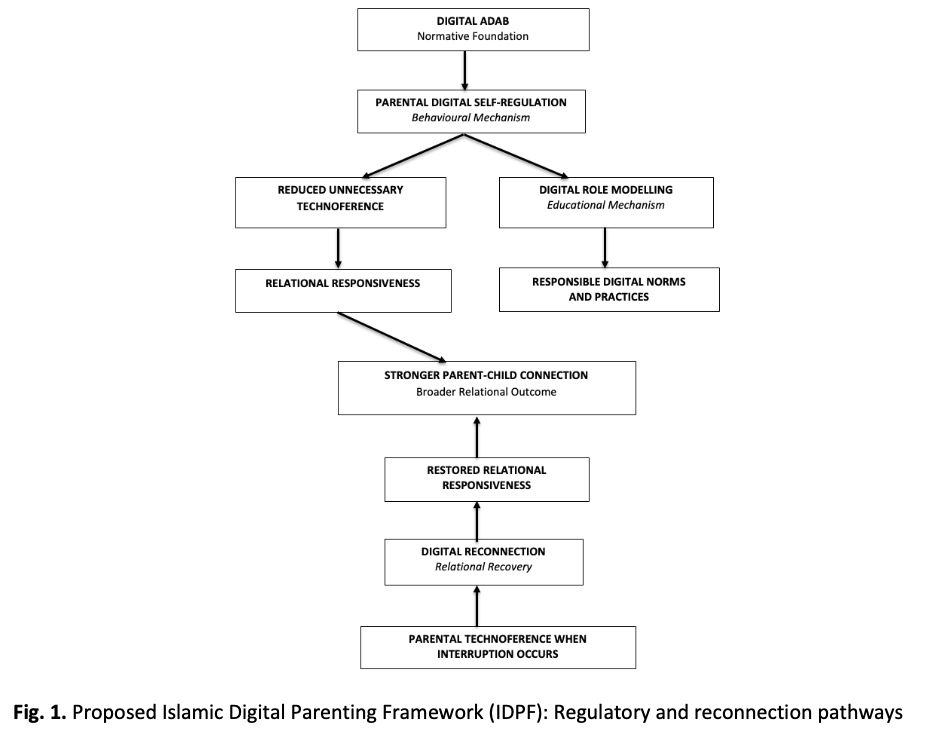
Digital technology has become embedded in family life, shaping how parents communicate, work, access information, and interact with their children. While digital parenting research has largely focused on children’s screen use, parental mediation, and online safety, less attention has been given to how parents’ own technology use may affect everyday parent-child interaction. One concern is parental technoference, where technology-related interruptions reduce parental attention and responsiveness. This conceptual study examines how Islamic education can inform a more relational approach to digital parenting by addressing parental technoference and parent-child interaction. An integrative literature review was conducted using Scopus, covering publications from 2016 to 2026, with selected seminal works retained to establish foundational concepts in Islamic education and adab. The review synthesised literature across three thematic domains: digital parenting and parental digital behaviour, parental technoference and parent-child interaction, and Islamic education, digital adab, and moral formation. Based on this synthesis, the study proposes an Islamic Digital Parenting Framework comprising four interconnected dimensions: digital adab, parental digital self-regulation, digital role modelling, and relational responsiveness. Digital adab provides the normative foundation, parental digital self-regulation serves as the primary behavioural mechanism for reducing unnecessary technoference, digital role modelling functions as an educational mechanism, and relational responsiveness represents the interpersonal mechanism of parent-child interaction. When technoference occurs, digital reconnection is conceptualised as a relational recovery process through which parental attention and interaction may be restored. The framework distinguishes between regulatory and reconnection pathways that are theoretically oriented towards supporting stronger parent-child connection. The study contributes a values-based perspective to digital parenting by shifting attention from regulating children’s technology use alone towards parents’ own digital conduct, moral responsibility, and relational responsiveness.