Teachers’ Social Skills and Classroom Management Effectiveness: Evidence From Sjkc Primary Schools in Penang, Malaysia
Authors
Muhammad Azlan Ithninin
Sektor Pembelajaran, Jabatan Pendidikan Negeri Pulau Pinang, 11700 Penang, Malaysia
Ummu Sakinah Subri
School of Educational Studies, Universiti Sains Malaysia, 11800 Penang, Malaysia
Ema Rozaini Sukim
School of Educational Studies, Universiti Sains Malaysia, 11800 Penang, Malaysia
Keywords:
Relationship Management, Social Skills, Emotional Intelligence, Classroom Management Effectiveness
Abstract
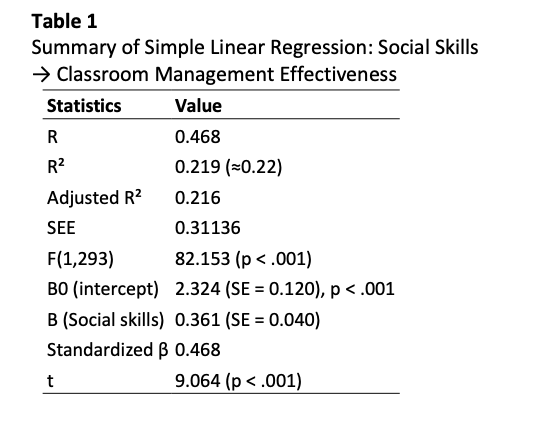
Effective classroom management depends on teachers’ interpersonal competencies as well as on pedagogical technique. Within emotional intelligence (EI), the relationship-management (social skills) domain covers how teachers communicate, negotiate, and manage conflict, which shapes whether a classroom stays orderly and engaging. Local studies have mostly treated EI as a single aggregate construct, so the specific contribution of social skills to classroom management in Malaysian primary schools is not well documented. This study examined the influence of teachers’ social skills (relationship management) on classroom management effectiveness among teachers in Chinese national-type primary schools (SJKC). A quantitative survey design was used: data were collected with a 63-item questionnaire in three parts and analyzed with simple linear regression. The population comprised 90 SJKCs in Penang (2,941 teachers). The study focused on the Northeast district (36 SJKCs; N = 1,106 teachers) for reasons of size and representation, and respondents were selected by simple random sampling. Teachers’ social skills explained approximately 22% of the variance in classroom management effectiveness. Continuing professional development (CPD) that targets communication, negotiation, conflict management, teamwork, and instructional leadership may therefore improve classroom management, and schools can build these competencies into coaching and professional learning community (PLC) routines to support transfer to practice.
Author Biographies
Muhammad Azlan Ithninin, Sektor Pembelajaran, Jabatan Pendidikan Negeri Pulau Pinang, 11700 Penang, Malaysia
azlan.ithnin@moe.gov.my
Ummu Sakinah Subri, School of Educational Studies, Universiti Sains Malaysia, 11800 Penang, Malaysia