From AI to Amanah: Redefining Entrepreneurial Success through Islamic Entrepreneurial Values
Keywords:
Artificial intelligence, Islamic entrepreneurship, amanah, responsible AI, stakeholder trust, sustainable entrepreneurial successAbstract
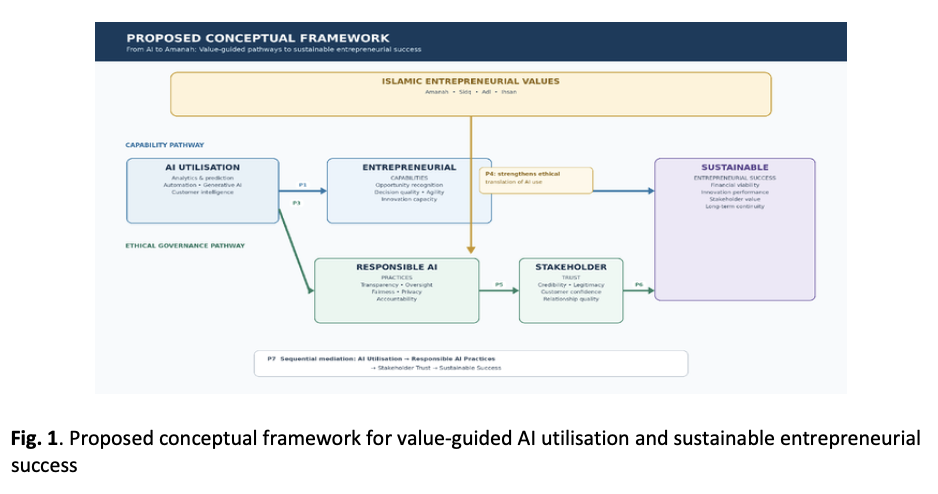
Artificial intelligence is changing how entrepreneurs recognise opportunities, make decisions, automate operations, communicate with customers and develop new offerings. These benefits, however, are accompanied by risks involving inaccurate content, privacy intrusion, algorithmic bias, opaque decisions and weak accountability. Research on AI and entrepreneurship has largely emphasised capability and performance, while the ethical foundations that shape how entrepreneurs use AI remain less developed. This conceptual paper examines how Islamic entrepreneurial values can guide responsible AI utilisation and broaden the meaning of entrepreneurial success. It synthesises literature on AI-enabled entrepreneurship, responsible AI, Islamic business ethics and sustainable entrepreneurial outcomes. The paper develops a dual-path framework. The capability path proposes that AI utilisation strengthens opportunity recognition, decision quality, operational agility and innovation capacity, which support entrepreneurial performance. The governance path proposes that amanah, sidq, adl and ihsan convert AI utilisation into responsible practices characterised by transparency, human oversight, fairness, privacy protection and accountability. These practices build stakeholder trust and contribute to sustainable entrepreneurial success. The framework therefore defines success through financial viability and innovation alongside stakeholder value, ethical legitimacy and long-term continuity. Seven propositions specify the relationships among the constructs and provide a basis for future empirical testing. The paper contributes to entrepreneurship and Islamic management literature by explaining when AI-generated capability can become ethically grounded and socially sustainable entrepreneurial value.