Maintaining Harmony in L2 Oral Communication: An Islamic Perspective on Apologetic Expressions in High-Stake Interactions
Keywords:
Apologetic expressions, high-stake interactions, interactional harmony, L2 oral communication, job interviews, politenessAbstract
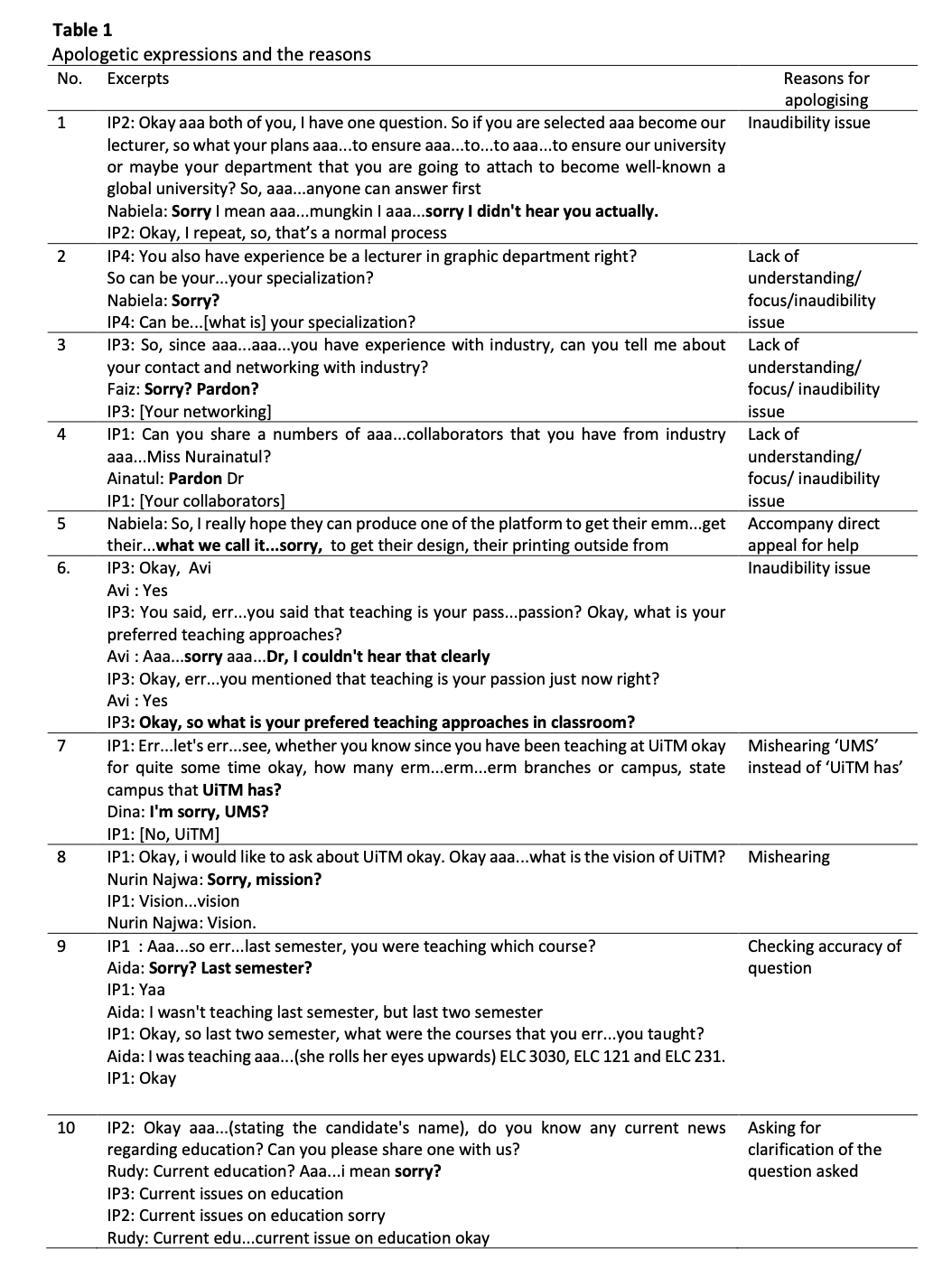
Any form of communication helps speakers to deliver their intended messages. Communication through oral interactions, however, has an additional purpose; to maintain harmony in interactions. In high-stake interactions such as job interviews, unfavourable elements such as misunderstanding or lack of clarity usually cause the candidates to seek assistance from the panellists such as repeating their sentences or providing clarifications. While this can be unpleasant to the panellists, the candidates usually try to tackle the situation by using apologetic expressions before revealing what they need the panellists to do. These expressions are seen from the Western perspective as strategic politeness markers while the Islamic perspective views them in relation of tawāḍu (humility) and ‘izzah (dignity). Interestingly, despite these different views, both perspectives see politeness expressions as the tools to maintain harmony in communication. The current study is therefore significant since it is built on the two different views which share a similar function of apologetic expressions in communication. The study aims to examine the use of strategic politeness markers “sorry” and “pardon” by interview candidates, the reasons behind them and how they help to maintain interactional harmony. The data were obtained from real academic staff recruitment interviews conducted in English at three university campuses in Malaysia. The interview sessions involving 47 Malay candidates were observed and video-recorded before they were analysed with the help of NVivo software. There were 13 occurrences of apologetic expressions, mainly to request the panellists to repeat their questions. The expressions also reflect respect for the panellists and acknowledge the presence of power difference and social distance between speakers. While this resulted in positive responses by the panellists, it led to interactional harmony, defined in this study as a mutual comfort of both parties after a communication difficulty is addressed through speakers’ the use of apologetic expressions that receives listeners’ positive responses. Despite this however, speakers are cautioned not to apologise excessively as this can signal incompetency. Based on the results, the study offers effective ways of language teaching in order to produce competent English speakers with a good balance of tawāḍu and ‘izzah.