Amanah and Tabayyun as Islamic Ethical Principles for Responsible Generative Artificial Intelligence (AI) use among Medical Imaging Students
Keywords:
Generative artificial intelligence, Medical Imaging education, Amanah, TabayyunAbstract
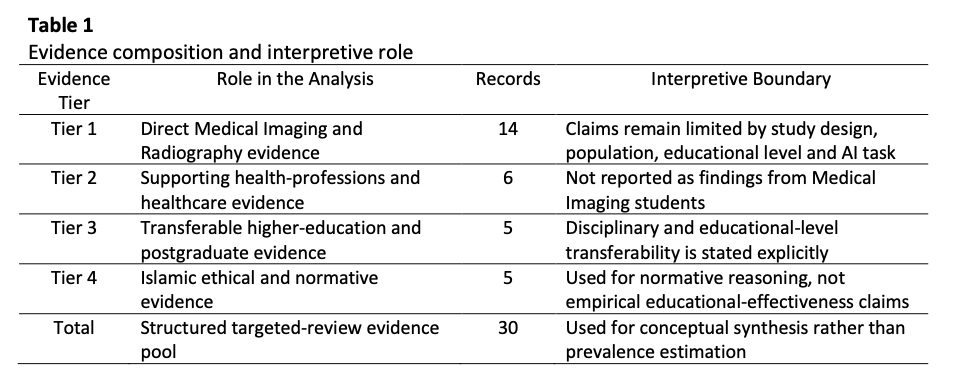
Generative artificial intelligence (GenAI) is increasingly used in higher education for learning, assessment, simulation, reflection and scholarly writing. In Medical Imaging education, GenAI may support learning but also raises concerns about factual reliability, fabricated references, academic integrity, overreliance, patient-data confidentiality and professional judgement. This study examined how Amanah and Tabayyun may guide responsible GenAI use among Medical Imaging students. A structured targeted review followed by Islamic ethical conceptual analysis was undertaken. Thirty appraised records identified through PubMed and Google Scholar search streams were organised into four evidence tiers: Medical Imaging and Radiography, health professions, higher education, and Islamic ethical and normative evidence. Findings showed that GenAI was relevant across academic, clinical and professional, and research and scholarly-writing contexts; although educational relevance did not establish effectiveness and human oversight remained necessary. Verification of claims, references, sources and context emerged as a recurring responsibility, while ownership of reasoning, disclosure, confidentiality and accountability remained human obligations. Amanah was interpreted as accountability for the purpose, conduct and consequences of GenAI use, while Tabayyun addressed verification of AI-mediated information. Maqasid-oriented reasoning further considered intention, method, outcome, benefit and harm, particularly Hifz al-‘Aql. Responsible GenAI use therefore requires accountable conduct and verified information.