Cognitive Offloading to ADAB-AI: A Framework for Responsible Generative Artificial Intelligence use in Higher Education
Keywords:
Generative artificial intelligence, cognitive offloading, ADAB-AI, higher educationAbstract
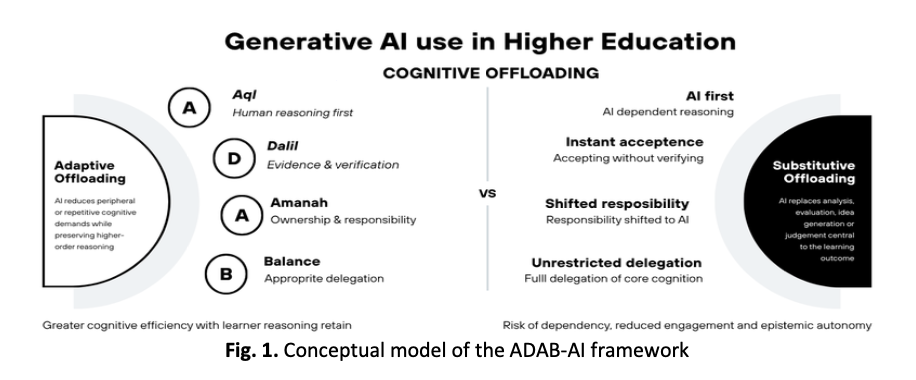
The effortless use of generative AI in higher education for immediate feedback and personalised learning support has raised concerns about cognitive offloading. Although parts of the cognitive process have long been offloaded to machines such as calculators and GPS, learners now delegate analysis, evaluation, idea generation and decision-making to AI systems. The argument for cognitive offloading is not inherently detrimental, as the educational consequences depend on the nature and extent of the cognitive processes delegated to AI. Therefore, a distinction is proposed between adaptive offloading, which reduces peripheral cognitive demands while preserving higher-order reasoning. Meanwhile, substitutive offloading occurs when AI replaces most of the cognitive processes essential for learning. The most critical part is the implications of these types of offloading on critical thinking, cognitive autonomy, academic integrity and student well-being. It further integrates the Islamic principles of adab (proper conduct) as ethical foundations for responsible AI use. Accordingly, an Islamic conceptual framework proposes the ADAB-AI Framework, which integrates AI in higher education through principles of Aql, Dalil, Amanah, and Balance. The framework that preserves Islamic concepts offers an ethically grounded approach to preserving cognitive autonomy, human agency, academic integrity and well-being in AI-supported higher education. Last but not least, the primary construct is to position AI as cognitive scaffolding rather than a substitute for human reasoning.