Digitalising Quranic Learning through Artificial Intelligence: LSTM-Based Verse Identification from Audio Recitations
Keywords:
Artificial intelligence, Quranic learning, Quranic recitation, LSTM, MFCC, verse identification, Tasmik, Muraja'ahAbstract
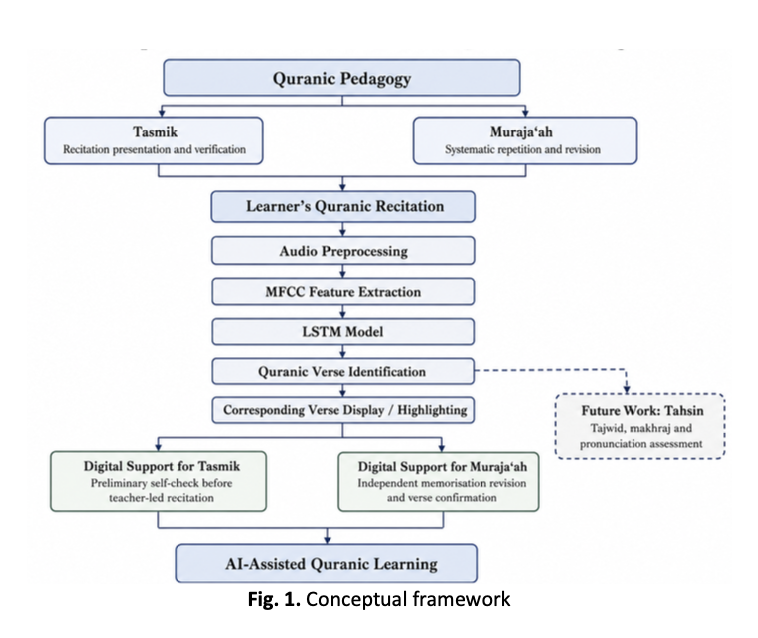
Artificial intelligence (AI) offers new opportunities to extend Quranic learning beyond static digital resources toward interactive recitation support. However, learners practising independently still have limited access to immediate verse-level recognition, while formal recitation assessment remains dependent on qualified teachers. This study develops and evaluates an AI-assisted Quranic verse-identification approach using Mel-Frequency Cepstral Coefficients (MFCC) and Long Short-Term Memory (LSTM), and demonstrates its integration into a mobile application as supplementary support for Muraja'ah and preliminary Tasmik. Audio recitations from Surah Al-Ikhlas, An-Nas, and Al-Fatihah were standardised, augmented, converted into 13-coefficient MFCC sequences, and classified using separate LSTM models. Performance was assessed using accuracy, precision, recall, F1-score, loss, and confusion matrices. Test accuracies were 90.21% for Al-Ikhlas, 70.75% for An-Nas, and 74.83% for Al-Fatihah, with most errors concentrated among specific acoustically similar verse pairs. The trained models were integrated into a mobile application that records a recitation and highlights the predicted verse. The findings demonstrate the feasibility of constrained MFCC-LSTM verse identification for independent revision, while confirming that the system should complement rather than replace teacher-led Quranic instruction. The current model does not assess Tajwid, makhraj, or pronunciation quality.