An Ecological Framework for Counsellor-in-Training Well-Being: Integrating Individual Developmental Resources and the Professional Learning Ecosystem
Authors
Azzah Sabrina Muhammad Shariff Paul
Department of Counselling, Faculty of Human Development, Universiti Pendidikan Sultan Idris, 35900 Tanjong Malim, Perak, Malaysia
Hapsah Md. Yusof
Department of Counselling, Faculty of Human Development, Universiti Pendidikan Sultan Idris, 35900 Tanjong Malim, Perak, Malaysia
Nurul ‘Ain Mohd. Daud
Department of Counselling, Faculty of Human Development, Universiti Pendidikan Sultan Idris, 35900 Tanjong Malim, Perak, Malaysia
Keywords:
counsellor-in-training, well-being, ecological framework, counsellor education, professional practice
Abstract
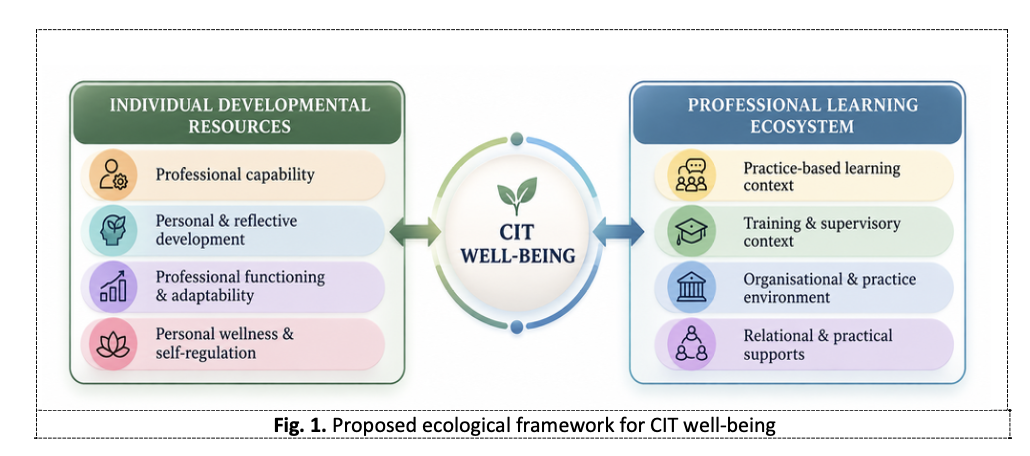
Counsellors-in-training (CITs) are students, supervisees, and developing professionals. Their well-being needs to be understood in relation to both their personal development and the conditions in which they train. This concept paper uses a targeted narrative synthesis of psychological well-being, holistic wellness, student well-being, supervision, and ecological perspectives to propose two interconnected dimensions: individual developmental resources and the professional learning ecosystem. The four subdimensions of individual developmental resources are professional capability, personal and reflective development, professional functioning and adaptability, and personal wellness and self-regulation, while those of the professional learning ecosystem are the practice-based learning context, the training and supervisory context, the organisational and practice environment, and relational and practical supports. The framework considers not only the abilities CITs develop but also the training conditions that help them apply these abilities, including cooperation between universities, supervisors and placement organisations. Hence, the paper presents three propositions on training alignment, disclosure of difficulties and practical access to training. Practical examples show how the framework may guide supervisors and institutions in supporting CIT well-being. The framework provides a guide for counsellor education and a basis for future empirical research on its proposed dimensions, relationships and practical effectiveness.
Author Biographies
Azzah Sabrina Muhammad Shariff Paul, Department of Counselling, Faculty of Human Development, Universiti Pendidikan Sultan Idris, 35900 Tanjong Malim, Perak, Malaysia
azzahsabrinamsp@gmail.com
Hapsah Md. Yusof, Department of Counselling, Faculty of Human Development, Universiti Pendidikan Sultan Idris, 35900 Tanjong Malim, Perak, Malaysia
hapsah@fpm.upsi.edu.my
Nurul ‘Ain Mohd. Daud, Department of Counselling, Faculty of Human Development, Universiti Pendidikan Sultan Idris, 35900 Tanjong Malim, Perak, Malaysia